Sustainable Development Technical Section

 View Only

10 Dysfunctions of Weak Sustainability - asking for your ideas

  • 1.  10 Dysfunctions of Weak Sustainability - asking for your ideas

    Posted 12-04-2022 11:54 PM
    Hello Respected SDTS Colleagues,

    Bottom line up front summary: Help me come up with the top 10 dysfunctions of the currently failing global ESG and weak sustainability system to help inspire a move to "strong sustainability".  

    ESG and reporting-driven "weak sustainability" has failed to move the needle towards bringing humanity back within planetary boundaries.  We live in a system with real limits, and when those limits are superseded, system equilibrium can seek and find a new set point, which may be far less hospitable to humans.  That's the basis of "strong sustainability" that uses system thinking to create a pathway to bring humanity back within planetary boundaries, and is inspired by natural systems to imagine a world wherein humans can thrive within those boundaries, regenerate nature, and leave the Earth in a better way than we found it for our children and their children.  If you're unfamiliar with the planetary boundaries concept, have a look here: Planetary boundaries.

    There's also a wonderful Netflix documentary wherein the Stockholm Resilience Center lays out the full story and backs it up with evidence. Here's a preview: Johan Rockström on Netflix documentary Breaking Boundaries and the graphic below highlights that 7 of 9 boundaries have already been crossed.  Not good folks...
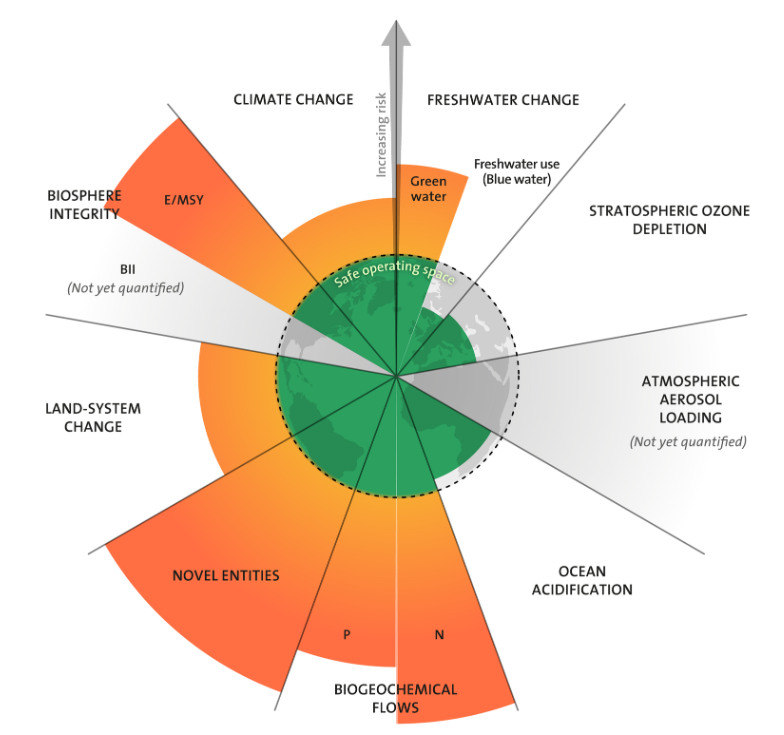
    So, that brings me to my request of this impressive and growing SDTS SPE Connect Community.  I hope this is more fun than wringing our hands about the above.  

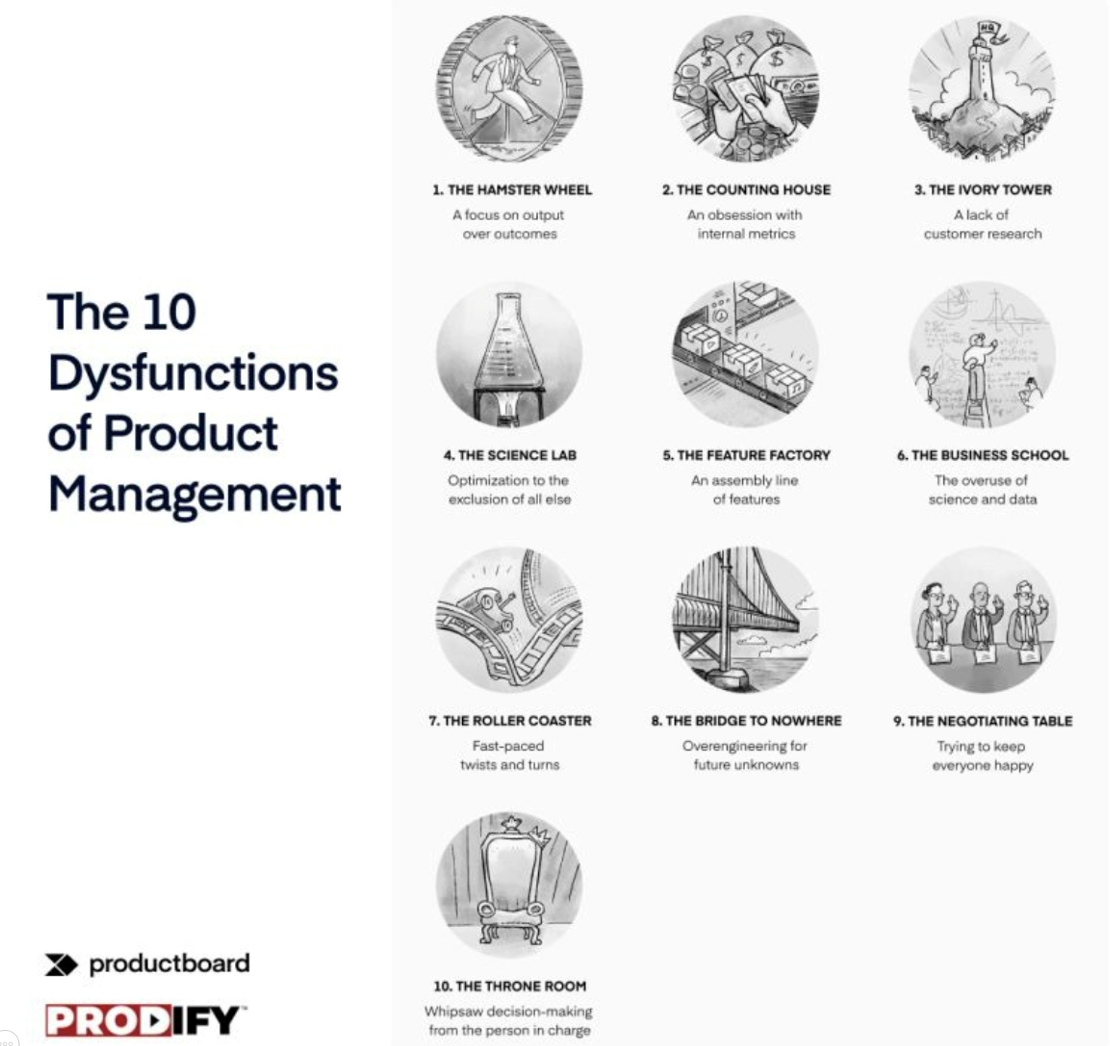
    Sometimes the best way to catalyze system-level change is to call out the failures of the current paradigm, and draw a stark contrast with the envisioned more promising future system. What if, through this conversation thread, we could come up with "The Top 10 Dysfunctions of Weak Sustainability" and make a fun graphic?  This could be included in the materials I and other ambassadors of the SDTS and Gaia are regularly presenting within and outside the SPE to help tell our story.  I'm inspired by the below graphic, and hope you are too.  Feel free to respond with one or more dysfunctions, and together, hopefully, we'll come up with a solid and compelling list.  


    ------------------------------
    Warm Regards,
    Josh Etkind

    Shell Upstream Deepwater Digital Transformation Manager
    SPE Sustainable Development Technical Section Chairperson
    SPE Gaia Sustainability Program Chairperson
    ------------------------------


  • 2.  RE: 10 Dysfunctions of Weak Sustainability - asking for your ideas

    Posted 12-06-2022 02:48 AM
    Josh,

    An interesting graphic on the overuse of our planet, I'll admit I had to look-up what the researchers were meaning by novel entities and found it to be a wide-reaching scope, covering plastics to synthetic chemicals. That however leads me to product design, both within and outside the energy industry.

    When we design any production facility, we set out at the beginning of the design with human safety at the core, setting our safety to a standard above that of the rest of the planet. As humans, that is the natural thing to do, but should we not design facilities to view the whole plant as needing to be kept safe? That shouldn't mean diminishing the safety of human life but putting the planet on an equal footing.

    I'll use hydrogen development as an example. We can see the benefits of developing a hydrogen economy as providing a route to decarbonisation whilst maintaining or creating jobs in communities that have been part of the hydrocarbon industry. Thus, we charge ahead without fully understanding the negative environmental impacts of production of hydrogen on a large scale. As increasing studies are showing, hydrogen leaked to the atmosphere will have indirect global warming effects, and hence we need to design to standards and rules we are perhaps not familiar with, any quick search will provide you with safe venting designs, you'll find it harder to find safety systems that state venting is bad for the environment.

    Methane leakage was for many years an overlooked GHG emission, with marine engine design an example where smart product design with good intentions forged ahead without fully understanding the implications. What we can't do, is follow that same direction with hydrogen, we need clean hydrogen to provide a decarbonisation route in hard to abate sectors, but we fundamentally have to account for the full environmental impact of the hydrogen, not assign it to the hard to figure out so we won't bother bucket. For the SPE to be part of the solution, and not the enemy of the energy transition we need to measure our impact fully and address the challenge head-on and that means fully accounting for our emissions and environmental impact now.

    The climate implications of using LNG as a marine fuel - International Council on Clean Transportation (theicct.org)

    ------------------------------
    Neil Rimmer
    Vysus Group
    Principle Consultant - Sustainable Development
    ------------------------------


  • 3.  RE: 10 Dysfunctions of Weak Sustainability - asking for your ideas

    Posted 12-06-2022 07:45 AM
    Neil,

    Excellent point substantiated by a very relevant and compelling example!  Thanks for sharing.  I hope we learn from all the retrofitting we're having to do to eliminate methane leaks from high bleed pneumatic valves, oil tank designs, pipeline compression, and many other leak points for the nascent hydrogen economy.  If we're designing H2 infrastructure with venting as part of the design, we're literally shooting ourselves in the foot.  Hydrogen is not an efficient energy carrier, nor is it cost competitive any time in the foreseeable future.  We're embarking on this journey for the purpose of reducing our impact on climate change.  If we're eroding the climate change benefit with poor design decisions, the entire concept of the hydrogen economy will be undermined.  We need to tighten up our act folks! We can and must do better.  We clearly know better!

    Another example of how we reduce "novel entities" impact is to re-use materials instead of disposing of them after one use.  This is where circular economy concepts make great sense.  Plastics recycling via pyrolysis is a growing trend for previously unrecyclable materials (including Styrofoam). 

    Another proof point: The billionaires of the future are those who will look at today's waste streams and see cheap feedstock to other value adding product and service production.  The circular economy is not just a moral imperative, it's a HUGE opportunity. For example: We must reimagine buildings as "urban mines' of potential. "The moral argument simply doesn't work," says Rau. "We have to organise our thinking along the financial axis." He calculates that, on average, the residual value of a building's materials equates to around 18% of the original construction cost – a huge bonus to the bottom line, considering clients are usually saddled with the cost of disposing of demolition waste, rather than reaping any reward from it. "We have to show that materials are a valuable asset, rather than an expense to be lumbered with."

    SOURCE: https://amp-theguardian-com.cdn.ampproject.org/c/s/amp.theguardian.com/cities/2020/jan/13/the-case-for-never-demolishing-another-building


    ------------------------------
    Warm Regards,
    Josh Etkind

    Shell Upstream Deepwater Digital Transformation Manager
    SPE Sustainable Development Technical Section Chairperson
    SPE Gaia Sustainability Program Chairperson
    ------------------------------


  • 4.  RE: 10 Dysfunctions of Weak Sustainability - asking for your ideas

    Posted 12-06-2022 05:29 AM
    Interesting post! Not sure you can blame "ESG and reporting-driven "weak sustainability" has failed to move the needle towards bringing humanity back within planetary boundaries."; when Sustainable Development clearly has! Sustainability, like Political Sustainability as demonstrated by COP27, is clearly in its infancy. Talk to 20 people what Sustainability means and you will get 20 different answers. I'd start there on the Thinking side more than proposing 'failures'.

    Irreversible Climate and Habitat Change is all around - so backwards looking Science based on Evidence is not a great solution todate. 1.5 DegC could be a end point, in more than one way. Do we have the time to get that Evidence through just Science? If not Planetary Boundaries are not going to be the whole solution. Ocean Research is also in its infancy in Deep Oceans - some 1/3rd of Our Planets surface. Can we wait another 20 years for 98% of Scientists to agree that research? Think we should just focus on Our Planet's Boundaries, and let the Scientists collect more White Data. Engineering will deliver the future, based on good Science.

    Maybe if the SPE dropped Sustainable Development and focused on Sustainability, like your 10 Dysfunctions - some progression could be achieved,


    Best
    Adrian


  • 5.  RE: 10 Dysfunctions of Weak Sustainability - asking for your ideas

    Posted 12-06-2022 08:00 AM
    Hi Adrian,

    I don't mean to "blame" ESG for societies ills.  Rather, my point is that it's not living up to full potential as it lacks comparability, and it lacks context within planetary boundaries.  How useful is it to know that company x has made an unmeasured, estimated improvement of 10% since last year on some arbitrary ESG metric?  What really matter is how much of the planet's stocks and flows of materials (renewable and non-renewable) are being used, and how much waste and damage is being created within the context of how much the full system can accommodate without undermining future generations. This is sometimes referred to as materiality.

    Even from a financial perspective, ESG has not yet proven itself to materially move the needle.  From the Financial Times Unhedged newsletter this morning, "The idea that ESG investing is going to change the world by changing cost of capital remains dubious; the idea that companies with low ESG are more risky than those with high ESG scores is hopelessly ambiguous in absence of valuations; whether ESG labelling meaningfully changes the market's response to those risks is up in the air; the conceptual muddles of the ESG industrial complex are not going anywhere; and none of this is getting better." "The second reason to expect a wider greenium [green investment premium paid for ESG-labelled bonds or equities], the authors argue, is that over time, as the meaning of ESG labels becomes clearer, investors will make shaper distinctions: "As investors agree on what constitutes 'good ESG' and 'bad ESG,' as well as good and bad progress, we see room for even greater divergence in debt costs." I have seen no evidence that this is happening, and no reason to expect it to, given that environmental, social and governance performance is often based on subjective assessments of contested values."

    I too am optimistic on engineering playing a role in delivering the future, as you state.  However, (if you permit me to generalize for the sake of making a point) engineers are NOT the most effective communicators to the public, where the consumption decisions are being taken.  Additionally, we often fail to fully engage the imagination and creativity of our own people and those in near orbits to collaborate to solve the most pressing problems.  Hence, this is why I'm making the request for real, tangible dysfunctions you perceive in the sustainability space to help us align on where we focus our future efforts.  Do you have any suggestions there?

    ------------------------------
    Warm Regards,
    Josh Etkind

    Shell Upstream Deepwater Digital Transformation Manager
    SPE Sustainable Development Technical Section Chairperson
    SPE Gaia Sustainability Program Chairperson
    ------------------------------


  • 6.  RE: 10 Dysfunctions of Weak Sustainability - asking for your ideas

    Posted 12-06-2022 08:49 AM
    Sent from my iPad


  • 7.  RE: 10 Dysfunctions of Weak Sustainability - asking for your ideas

    Posted 12-06-2022 08:58 AM
    It is interesting you have not discussed the short comings of Sustainable Development ideology. ESG is at least part of Corporate Sustainability Reporting, therefore will be developed and matured when companies start fully addressing Sustainability; ie Materiality & Proficiency.

    As for spokes-persons, Engineering is just as good as Scientists in communication. Yet, COPs to date seem to disrespect the Science and Knowledge. 1.5 DegC world is poorly understood until we experience it - giving Science the evidence they need. That could be too late, some Scientists believe. I'll stick to being an Engineer.

    Rather than focus on the glass half empty - I'd focus on moving forward, Engineering the Future.


    best
    Adrian


  • 8.  RE: 10 Dysfunctions of Weak Sustainability - asking for your ideas

    Posted 12-06-2022 10:44 AM
    Adrian,

    The point of this thread is a request to the community to identify the dysfunctions (short comings) of sustainability, not just talk about it in general terms. I agree there are dysfunctions. This is my effort to use an open-source approach to solicit input from the community. Can you share a couple dysfunctions from your perspective? You have lots of relevant experience and expertise on this front.

    Regards,
    Josh


  • 9.  RE: 10 Dysfunctions of Weak Sustainability - asking for your ideas

    Posted 12-06-2022 12:23 PM
    Josh, I've already mentioned the two biggest, 1) talk to 20 people about Sustainability, you get twenty different answers (hence why I wrote 10 Sustainability Articles in the London SPE Review). 2) Climate Science is based on Evidence, and we past the point of irreversible Climate and Habitat Change around 1 DegC rise. Just read the latest IPCC reports. 1.5 DegC will certainly not be a safe space to live for many millions, even billions, as currently demonstrated. We shall find out so no need debating this! The North will be safer than the South. Hence we need to engineer the future, based on good science, focusing on Our Planet's Boundaries. Science without evidence is flakey as Reservoir Engineers know so well… planetary boundary science is still evolving, eg DeepOceans.


  • 10.  RE: 10 Dysfunctions of Weak Sustainability - asking for your ideas

    Posted 12-06-2022 04:14 PM
    Ah, all clear Adrian,

    Thanks for clarifying. Great points that do resonate. So, to keep a running tally of feedback on the 10 Dysfunctions of Sustainability for others to build on:

    From Adrian Gregory:

    1. No aligned definition of Sustainability - everyone can work towards their own custom definition (I could extend this to also include too many ESG frameworks that aren't comparable)
    2. Anthropogenic climate change is still debated - still lacking indisputable evidence today to convince everyone to get on board; scientific long-term forecasts don't resonate with everyone, even though most scientists agree we're already seeing impacts from having risen 1 degC from pre-industrial levels.
    From Jeanne Perdue

    1. Lack of systems thinking taking full product life-cycle into account for decisions - Weak sustainability is not considering the waste products of a system, be they emissions or trash or noise. Strong sustainability is having a use for all waste products, such as CO2 sequestration or recycled plastic and glass.

    What else folks?

    Regards,
    Josh


  • 11.  RE: 10 Dysfunctions of Weak Sustainability - asking for your ideas

    Posted 12-07-2022 07:41 AM
    Josh sorry by this is not what I sent you above: "From Adrian Gregory:

    1. No aligned definition of Sustainability - everyone can work towards their own custom definition (I could extend this to also include too many ESG frameworks that aren't comparable)
    2. Anthropogenic climate change is still debated - still lacking indisputable evidence today to convince everyone to get on board; scientific long-term forecasts don't resonate with everyone, even though most scientists agree we're already seeing impacts from having risen 1 degC from pre-industrial levels." This is from Josh!

    ESG frameworks are design by Sectors so they are not designed to be comparable! Suggest you read my 10 articles and we take this offline.  For those interested what I actually said - read what I posted..


    best
    Adrian

    ps still waiting for your response what you thing about Sustainable Development failures…


  • 12.  RE: 10 Dysfunctions of Weak Sustainability - asking for your ideas

    Posted 12-07-2022 08:00 AM
    Josh, also it is very important to be transparent with the facts: we are actually now at 1.3 DegC temperature rise, and at 420ppm CO2. 450ppm CO2 was the Climatic Disaster level presented at COP26, for Climate Tipping points of accelerated global disasters; even more than we see increasingly 'happenings', eg Super Storms in Florida and flooding in Pakistan.


  • 13.  RE: 10 Dysfunctions of Weak Sustainability - asking for your ideas

    Posted 12-08-2022 10:16 AM
    Sent from my iPad


  • 14.  RE: 10 Dysfunctions of Weak Sustainability - asking for your ideas

    Posted 12-06-2022 08:55 AM
    Dear Josh:
    Weak sustainability is not considering the waste products of a system, be they emissions or trash or noise.
    Strong sustainability is having a use for all waste products, such as CO2 sequestration or recycled plastic and glass.
    Love, Jeanne

    Jeanne M. Perdue
    Technical Writer, Oxy
    Houston, TX


  • 15.  RE: 10 Dysfunctions of Weak Sustainability - asking for your ideas

    Posted 12-06-2022 10:37 AM
    Great example! Thanks for sharing Jeanne!

    ------------------------------
    Warm Regards,
    Josh Etkind

    Shell Upstream Deepwater Digital Transformation Manager
    SPE Sustainable Development Technical Section Chairperson
    SPE Gaia Sustainability Program Chairperson
    ------------------------------


  • 16.  RE: 10 Dysfunctions of Weak Sustainability - asking for your ideas

    Posted 12-07-2022 07:27 PM

    Hi Josh

    i will stay on a very basic but pragmatic observation: many installations that are designed for a project are obsolete ten or twenty years later. They become difficult to maintain and/or are no longer known by the staff. I have in mind the example of a subsea well head in the North Sea that became unserviceable and even not replaceable long before the well had exhausted its reserves, or that of pneumatic PIDs that were the norm in the eighties and are now unknown to young engineers although still in place on many fields. You can find many more examples.

    Of course there are technical reasons for such changes; it's called progress. But is that really always a sustainable path or is it not in many cases a kind of programmed obsolescence forcing to spend money and resources on updating systems that were perfectly functional? 


    ------------------------------
    Jean-François Verpeaux
    Retired from Total Paris

    Disclaimer: my personal opinion only
    ------------------------------


  • 17.  RE: 10 Dysfunctions of Weak Sustainability - asking for your ideas

    Posted 12-07-2022 11:24 PM
    Dear Jean-Francois:

    Many thanks for taking the time to share this important point. Indeed, we live in a time with prevalent planned obsolescence. The negative impact of that philosophy is compounded by the fact that most of these items are not recyclable or easy to repurpose. As a result you end up not only in a linear economy (resource extraction, processing, manufacture, refuse), but one with short useful lives. A more circular economy would require future-proof (forwards compatible) products, or at least products and elements that are easy to upgrade and swap out.

    I quite like your tangible examples from the oilfield, which makes all of this more relatable for Petroleum Engineers and highlights how we can play a role in creating more sustainable solutions that reduce material input requirements, maximize useful life and value generation, and minimize waste. I’d posit that economically recoverable reserves left behind is a form of waste.

    I’m left trying to reframe your comments as a dysfunction of the current sustainability paradigm. I don’t want to put words in your mouth, extrapolate, or misquote you. You’ll note further down in this thread, I already upset a respected colleague doing the same.

    Could you take a shot at reframing as a dysfunction? Is it about a lack of incentives for manufacturers to create durable, long life, forward compatible, upgradable, products that also can be re-purposed or recycled?

    Regards,
    Josh


  • 18.  RE: 10 Dysfunctions of Weak Sustainability - asking for your ideas

    Posted 12-13-2022 05:12 PM
    Hi Josh
    Sorry for the delay; and no problem with any misquoting - I find it actually a bit difficult to reframe my point according to your definition of dysfunction, but let's have a go
    - Training based on the current technology is not sufficient as on one hand this technology will become obsolete and be replaced by another; and on the other hand because installations that are on the fields may belong to different generations. A sustainable training would enable staff to use different vintages of technologies and have an in depth understanding of physics before technology. This is rather general; I gave the example of pneumatic PID as opposed to digital technology but you could also mention drillers who don't know how to throw the chain any more; or in another discipline some engineers trained in using reservoir simulators do not know about the Kidder solution to the edge coning problem. Hence training that is too much linked to tools is rather dysfunctional in my view - now of course an engineer must also be very proficient in the use of tools and there is a limit to how long back in time you must know stuff;
    - For technologies I think the aerospace industry should be a good inspiration: at the same time that there are fly-by-wire Airbus and Boeings there also still are C47 flying around the world carrying goods or people, and all these different generations of planes keep being maintained and airworthy. A dysfunctional industry is an industry where workable systems are no longer serviceable and become obsolete; there are lots of examples in the Oil and Gas. This said and to come back to the pneumatic PID example, there are cases where an old technology should either be phased out or upgraded, not because it does not work but because it results in unacceptable pollution (in this case methane emissions). This can sometimes be fixed by the equivalent of putting a GPS on the DC-3 dashboard, hence sustainability could consist in upgrading whenever possible rather than replacing.
    In my view the two aspects - technologies and training - are very intimately linked. In the aerospace industry this is materialized by a systematic lessons learned system. I am not sure we have that culture in our industry and this absence may also be part of the lack of sustainability and is a dysfunction in itself.

    Hope this makes sense to you!
    Regards   


    ------------------------------
    Jean-François Verpeaux
    Retired from Total Paris

    Disclaimer: my personal opinion only
    ------------------------------


  • 19.  RE: 10 Dysfunctions of Weak Sustainability - asking for your ideas

    Posted 04-12-2023 09:03 AM

    Hi Josh. This is an old thread... is this considered closed, or still live?
    I find it is still relevant, particularly in the context of future decom activities.
    Pls let me know - we might be better off reopening a new one?
    Cheers.


  • 20.  RE: 10 Dysfunctions of Weak Sustainability - asking for your ideas

    Posted 04-23-2023 01:51 AM

    Hi Pierre-Edouard Vincent:

    Thanks for your response. Yes, I am still leading the SDTS as 2023 Chairperson.  Happy to connect with you to discuss collaboration with the P&A TS.  I also accepted your LinkedIn invite and sent you a message there.

    If you have thoughts on the below post, I'm open to hear them as well :)

    Regards,
    Josh


    ------------------------------
    Warm Regards,
    Josh Etkind

    Shell Upstream Deepwater Digital Transformation Manager
    SPE Sustainable Development Technical Section Chairperson
    SPE Gaia Sustainability Program Chairperson
    ------------------------------


  • 21.  RE: 10 Dysfunctions of Weak Sustainability - asking for your ideas

    Posted 04-23-2023 06:41 AM
    Edited by Pierre-edouard Vincent 04-23-2023 08:59 AM

    Hello Josh / community,

    Pardon the mess and possibly lack of clarity in my response below: this is new to me, and so some elements in my list might be "off topic" for you, but they form parts of my own reflection so far... so here's a potpourri / shot at a few challenges in Sustainability (as I see them):

    The 1st one is having to build a consensus... this is necessary & unavoidable, however in some cases having to negotiate a consensus will result in weaker measures taken. And when having to act fast (emergency), having to build a consensus can be impractical. Accepting that, even if only a few actors take a clear lead in a few key areas, albeit with a limited impact (as opposed to global), it might be a weak approach but a good practical one (stepped approach).

    Lack of education / awareness / recognition in the general population:

    The tragedy of the "Global Commons" - this is a key aspect IMHO. Once analyzed this way it becomes obvious that 1- we cannot leave the policing / regulatory aspect purely to individual states... a strong "global police" is also needed. This tension between local governments and global governments makes it a challenge for strong sustainability. However, various stakeholders can help in this... (civil society, whistleblowers...) leveraging on the power of multiple agents and local communities could be a key
    2- the "selfish" approach (at many levels) is key in shaping many of our actions... how do we face some ugly unavoidable traits of human nature (selfishness and greed come to mind) and just account for those...? Education? Safeguards?

    Regulations:

    Regulating for results, good governance (we cannot just expect corporate governance to become fully virtuous) and sustainability is a real challenge: how can this be done effectively?
    Prescriptive trap (vs. goal setting) - many regulations are prescriptive, which puts the burden of the adequacy/accuracy of prescriptions onto regulators... this is impractical in many cases due to assymetry of knowledge and financial resources between the corporate world and civil society (the corporate world has the knowledge and more financial resources that civil society)
    A practical way to address this is to be less prescriptive and more "goal setting" in regulations.
    Tackling the assymetry of knowledge is a bit more tricky (we can expect pushback against greater transparency)

    In a few key areas, paradigm shifts would help deliver stronger governance: the "The Polluter Pays" principle implemented in Europe (What is the polluter pays principle? (lse.ac.uk)) is one of those major shifts. We need more for stronger sustainability.

    Technology: it can be tempting to believe that "technology will save us", but the approach (and belief) clearly has limits and should not be used to justify inaction (IMHO).

    I was going to forget a big principle to help tackling weak sustainability (linked to better governance): for safeguarding public interests and prevent corruption, (we) citizens should demand (and settle for no less) that anybody with a social mandate or representation role should publish their wealth and tax documents (themselves and close family...)

    Rgds.


  • 22.  RE: 10 Dysfunctions of Weak Sustainability - asking for your ideas

    Posted 04-23-2023 10:51 AM

    Adding an interesting perspective (LSE) on the risk of "stranded assets" and encouraging greater disclosure of risks.
    What are stranded assets? - Grantham Research Institute on climate change and the environment (lse.ac.uk)


  • 23.  RE: 10 Dysfunctions of Weak Sustainability - asking for your ideas

    Posted 04-23-2023 02:59 PM

    Pierre-edouard:

    Thanks for contributing to this thread.  I appreciate your well thought out points, most of which reveal dilemmas we must contend with to create positive change at scale.  

    I find the first two points, consensus building and need for more public energy education linked.  It's even harder to build consensus between ill-informed people, or people who only receive biased or intentionally false information.  In our recent Gaia Summit in Muscat Oman in March, we openly discussed the need for our industry to engage more actively with the public to tell our story and share our perspective, starting with younger kids to help in their educational journey.  However, our conventional approach of spouting facts and figures fails to resonate with most people, and is ineffective at countering the prevailing misinformation-laden public news cycle.  The consensus of the attendees at the summit was that we would benefit from telling human stories that engage emotions and create a personal connection to our experiences and perspective.  

    On the Regulations point, I believe the term you may be reaching for is "intent-based regulation" when you say "goal setting".  Being too prescriptive can indeed squelch innovative solutions to achieve the same desired outcomes.  Regarding your point on the information asymmetry, in the Gaia Summit we also spoke about more transparency, and also about "Measuring What Matters". Too much of our external reporting is based upon estimates and calculations, many of which are uncalibrated by sufficient measurements to prove accuracy. Additionally, many of the measures are not "decision grade," nor are they contextualized against planetary boundaries, or even regional/ecosystem-level proportionality. A good example may be water use where a plant that produces some product could be calculating water use based on production, rather than measuring it which can miss leaks or temporal fluctuations due to confounding variables.  Additionally, in the reporting for this factory, they may tout their reduced water use of 10% versus the prior year, but not contextualize it by explaining that 1) they are pulling so much from the aquifer that the influx rate can't keep up with the withdrawal rate causing an unsustainable situation that may be causing subsidence that is damaging houses and roads in the area, and 2) due to this plant using so much water, other agricultural users withdrawing water from other less productive areas of the aquifer may not be able to obtain enough water to maintain their food production, something the regional community depends upon for affordable and low carbon footprint local crops.

    Finally, on your Paradigm Shifts point, the polluter pays principle is interesting. But it's not clear to me whether, for instance, in our industry if the producer of the natural gas would pay, or the electrical utility that burns the gas to produce power, or the people who buy that power.  If incentives are to truly move the needle, consumers need to feel the pain in their pocketbook to shift behavior.  Admittedly, if the utility pays, those additional costs will be passed through to the consumer. 

    I'm open to others views from this community.  We have a lot of expertise sitting around this virtual table :) 


    ------------------------------
    Warm Regards,
    Josh Etkind

    Shell Upstream Deepwater Digital Transformation Manager
    SPE Sustainable Development Technical Section Chairperson
    SPE Gaia Sustainability Program Chairperson
    ------------------------------


  • 24.  RE: 10 Dysfunctions of Weak Sustainability - asking for your ideas

    Posted 04-23-2023 03:22 PM

    Hi Josh,
    Thanks for the feedback. I suspected (and now understand) you are better prepared and much better informed than myself ;) I agree that information and education are often limited and could be improved (powerful lever). The labelling on food products would provide a good example of this: when provided with more info on salt, fat and other additives (and info on the way the product was created, animals farmed) the consumers can clearly make a more educated choice! Same for energy, waste, etc
    Kind rgds