Well Integrity Technical Section

 View Only
  • 1.  well barrier during conventional perforation in overbalanced condition

    Posted 09-21-2022 01:18 PM
    Hi all,
    What are the minimum well barrier requirements during conventional wireline
    perforation in overbalanced condition in a cased hole. If the well becomes
    active after perforation, what will be the barrier against wireline?
    Well was closed by the Annular BOP against shooting nipples and the
    wireline perforation gun size is 4 1/2".

    If there is any standard industry guideline, please advise.

    With kind regards,

    *Prashant Motghare*


  • 2.  RE: well barrier during conventional perforation in overbalanced condition

    Posted 09-24-2022 01:14 AM
    Good day to all
    Eagerly waiting for expert comments on this issue from others.

    I would like to share a few caution points(From literature by Howard Crumpton) regarding the usage of shooting nipple: 
    • Has the equipment been properly tested and certified to ensure it is capable of withstanding maximum closed-in wellhead pressure?
    • Check the shooting nipple dimensions are compatible with the drilling BOP with regards to length and diameter. Pipe rams or the annular BOP must form a pressure-tight seal around the body of the shooting nipple. The shooting nipple must not prevent the closure of the blind ram.
    • If pressure is observed at the surface, how easy will it be to regain control of the well? If gas reaches the surface the bullhead velocity will
    need to be higher than the gas migration velocity. In a clear brine, migration velocity can be significant and it might not be possible to
    pump down large diameter casing at the necessary rate.
    • Bullheading risks fracturing or damaging the formation. If a shooting nipple is used, it is advisable to include a pump-in tee. This would enable the well to be killed with the pressure control equipment still in place.
    • There have been several serious incidents when using shooting nipples; mostly whilst perforating. Before using a shooting nipple, the risks
    must be properly understood and assessed. Some shooting nipple failures have been a direct result of poor manufacturing standards, such as shooting nipples being manufactured in local machine ships and fabrication yards with little or no quality control. Other problems have been a direct
    result of poor practice and incorrect use. 


    When rigging up pressure control equipment during a completion consider the following:
    • A gate valve(s) (manual or actuated) should be used to provide isolation for the installation and removal of tools from the lubricator.
    Normally two valves will be used to ensure double valve isolation when breaking the lubricator.
    • Most rig-ups will include a pump-in tee for circulation/well kill/stimulation. This should be equipped with double barrier isolation (normally 2 x 1502 lo-torque valves).
    • If a tee is included in the rig up, it should be located above the gate valve
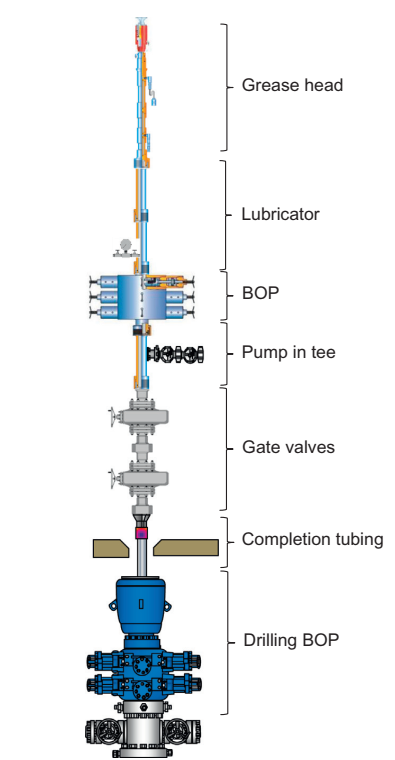
    Any other inputs from others are most welcome on this topic. 

    - Kishore Acharya


  • 3.  RE: well barrier during conventional perforation in overbalanced condition

    Posted 09-25-2022 07:53 AM
    Hi Prashant,

    The unhelpful answer will be that the number of barriers depends on risk. Since you talk about the well becoming "active", then I would assume you need two barriers.
    The problem is that the barriers will not be independent, but they will share common well barrier elements; anything between the tubing hanger and the wireline BOP is likely to be part of both the primary and secondary barriers (see e.g., NORSOK D-010 rev.5, fig.55). Basic risk management says that if you cannot rely on redundancy to reduce the probability of failure, then you must improve reliability of the common elements through other means - the easiest being inspection, testing, and preventive maintenance (of course there are a few other measures, such as training).
    In detail, your primary barrier ends at the the stuffing box, whereas your secondary barrier includes the wireline BOP.

    Was your question about what to do if the well starts flowing when the guns are across the BOP?

    A little note: did you mean underbalanced instead of overbalanced? It is puzzling that after drilling safely the well becomes underbalanced. Is that because you displaced to a clear kill fluid that can leak off into the reservoir?

    Best regards,

    ------------------------------
    Matteo Loizzo
    Well integrity consultant
    matteo.loizzo@mac.com
    Berlin, Germany
    ------------------------------


  • 4.  RE: well barrier during conventional perforation in overbalanced condition

    Posted 09-26-2022 04:06 AM
    Prashant, a shooting nipple can not be called a qualified well barrier element, as far as I know. It is often referred to as an oil saver, and is typically used on land rigs instead of a wireline BOP when perforating zones which cannot flow by itself before stimulation. The stuffing box may hold back a very low pressure/very low flow situation, but that is all it can be used for, keeping the drillfloor cleaner, basically. If you should have a well control situation after perforating, you will need to know that the BOP shear rams can shear and seal the nipple with a wireline inside, and depending on where you are operating, good luck with convincing the regulators that you can do that. Back in my days, this was an issue also with PCL/TLC (pipe-conveyed WL logging), and I don't think it was ever fully resolved, feel free to correct me if I am wrong.


  • 5.  RE: well barrier during conventional perforation in overbalanced condition

    Posted 09-26-2022 04:25 AM
    Thanks all for sharing your knowledge.
    Regards,
    Prashant
    --
    *Prashant Motghare*
    *General Manager (Drilling)*
    *Well Control School*
    *IDT, ONGC, Dehradun*


  • 6.  RE: well barrier during conventional perforation in overbalanced condition

    Posted 09-26-2022 07:29 AM
    Hi Prashant,

    To add to the comments above, I want to raise some concerns about closing the annular BOP around the shooting nipple. 
    • Depending on the surface pressures, a great piston force is expected against the shooting nipple.
    • The annular preventer is not designed to prevent axial movement of the pipe. Indeed, it is designed to allow it.
    • Even if a hold-down adapter is used, the axial movement cannot be prevented and there is a high chance of damaging the annular element.
    • The shooting nipple needs to be bolded on the top of the BOP. 

    I hope the points mentioned above are relevant to your operation.

    Best regards,

    Tasso


  • 7.  RE: well barrier during conventional perforation in overbalanced condition

    Posted 09-26-2022 09:04 AM
    If a shooting nipple is made up properly, it'll be part of the well barrier envelope, on land as well as offshore.
    Regular rig up for UB or at balance perforation or production logging: (Kishore already added the schematic)
    1. Rig (drilling or workover) BOP,
    2. Shooting nipple (HP riser from the production tree or BOP to working level. May be a 0.5 to 50 m long depending on where you operate),
    3. Wireline BOP (if desired/required),
    4. Lubricator (if the whole situation will be underbalanced before or after perforation),
    5. Stuffing box (good for a few hundred psi if not a thousand)

    As the bell nipple is likely already made up to the BOP, bolting a shooting nipple to the BOP will be complicated. Care must be taken to ensure it is a qualified and accepted design, and procedures are clear regarding installation. Accidents have happened when the nipple slips down, across the rams. This will prevent them from closing and we all know where that leads to. Hence, there is reluctance around using shooting nipples.

    As Matteo says, there will be common elements to the barrier envelopes that one simply cannot escape. The stuffing box/grease head is the primary and your wireline BOP the secondary barrier as you cannot rely on the fluid in the well. Depending on where you are, you may have wire-cutting shear rams or a wire-cutting production tree master valve, or a SSSV. This all depends on the operation and where you are with your tools. You may also have a formation isolation valve you can close with annulus pressure once the tools are above the valve.
    Hope this helps somewhat...
    Matthias