Hello community,
This will be an intro message to gauge interest in progressing a discussion on advanced modelling of eruptivity / Transient Flow Analysis in depleted Subsea wells...
I attended an SPE webinar not long ago where Ranold presented some CFD work done for their clients, and as a follow-up I asked Morten Hansen Jondahl if they had also worked on modelling cases for marginally-eruptive subsea wells, with a view of adjusting their risk-profiles, and potentially an approach to risk... He told me they have "sort-of" worked on this, but not really and that they would be interested in discussing further.
I offered to collaborate through SPE between Brazil and Norway (for instance, as a start), since we have worked on such cases using OLGA, ANSYS and more recently ALFASIM and could share info on practical cases.
If what I'm writing is too cryptic ;) here's a quick explanation:
- Eruptive wells: many wells are clearly capable of natural flow – those will not be the topic of interest here
- Dead wells: few wells would be so depleted (and with a high BSW) that they might not even be capable of flow to the seabed against the hydrostatic of seawater – those will not be the topic of interest here either
- And then in between there will be many wells which would be able to flow should an integrity issue arise, but maybe not always, and maybe not for a long time (sustained flow) – those wells would be the topic of interest (for risk-ranking and prioritizing)
Take a gas-lifted heavy oil producer well in a carbonate reservoir, with high BSW (say 85%), very low GOR and a depleted BHP in a mature oil province.
Due to phase segregation in the tubing, THSIP is still likely to build up after a long shut-in period. So, this well might actually be observably leaking gas bubbles in case of minor integrity issues… (SITH gas pressure being clearly above seawater hydrostatic)
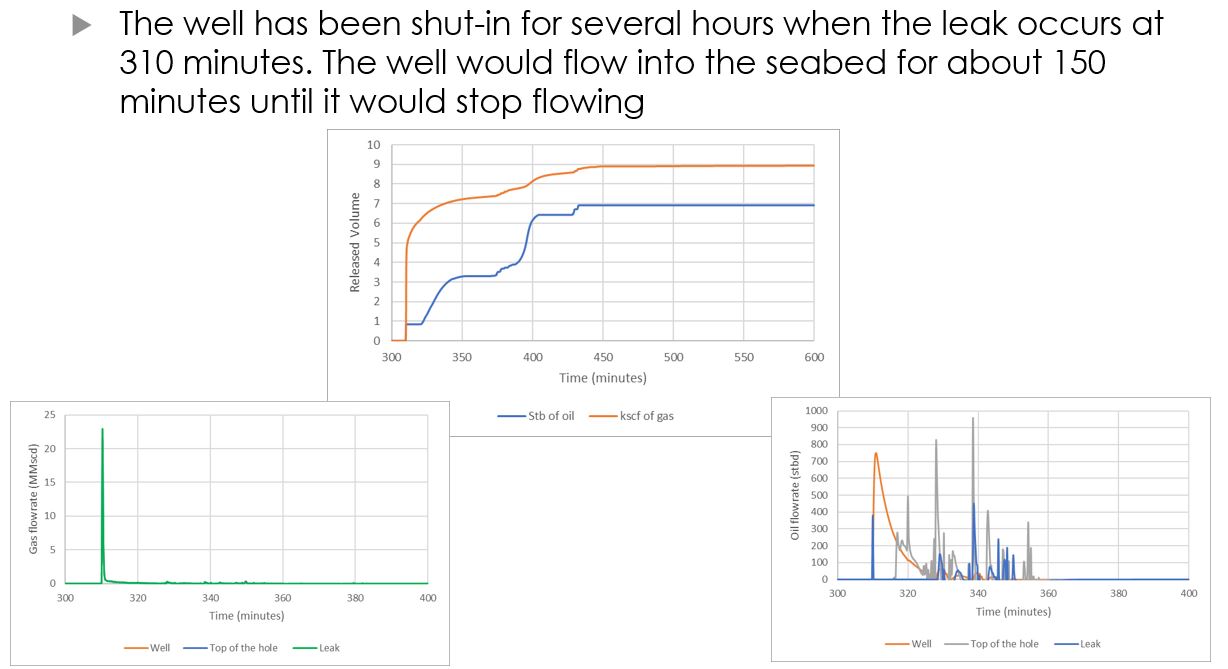
However, in case the XT would catastrophically fail (this is boundary condition, not necessarily the most likely scenario) this would lead to a transient flow period during which 1- the gas would vent out of the tubing, followed by 2- a flush oil production, then 3- a "steadier-state" production of reservoir fluids entering the tubing (open to the seabed after the catastrophic failure). What would happen beyond this is the topic of interest for specific Transient Flow Analysis to help adjust the risk profiles of some wells…
If Transient Flow Analysis (using OLGA, ANSYS, ALFASIM) determines that some wells might release only a finite and limited amount of oil (a few barrels for instance) before they would be killed by ambient seawater (inverting the flow… in cases the seawater would actually go South and into the depleted reservoir) then an operator could reasonably adjust the risk profile of that well and chose to focus on wells with a higher risk profile (for instance those which would clearly continue to flow…).
See below attachment (if I can upload it) for an illustration of a study case where a well would release 9kscf of gas and 7stbo in about 150min after it would be dead (only in the case of catastrophic XT failure).
If there is interest in progressing a discussion on this please respond with your own experience or pm me. I see this could lead to a short topical workshop/call and perhaps a presentation?
Rgds.