HyFTS July Monthly Webinar Coming Up
Please join us for our SPE Hydraulic Fracturing Technical Section Monthly Webinar!
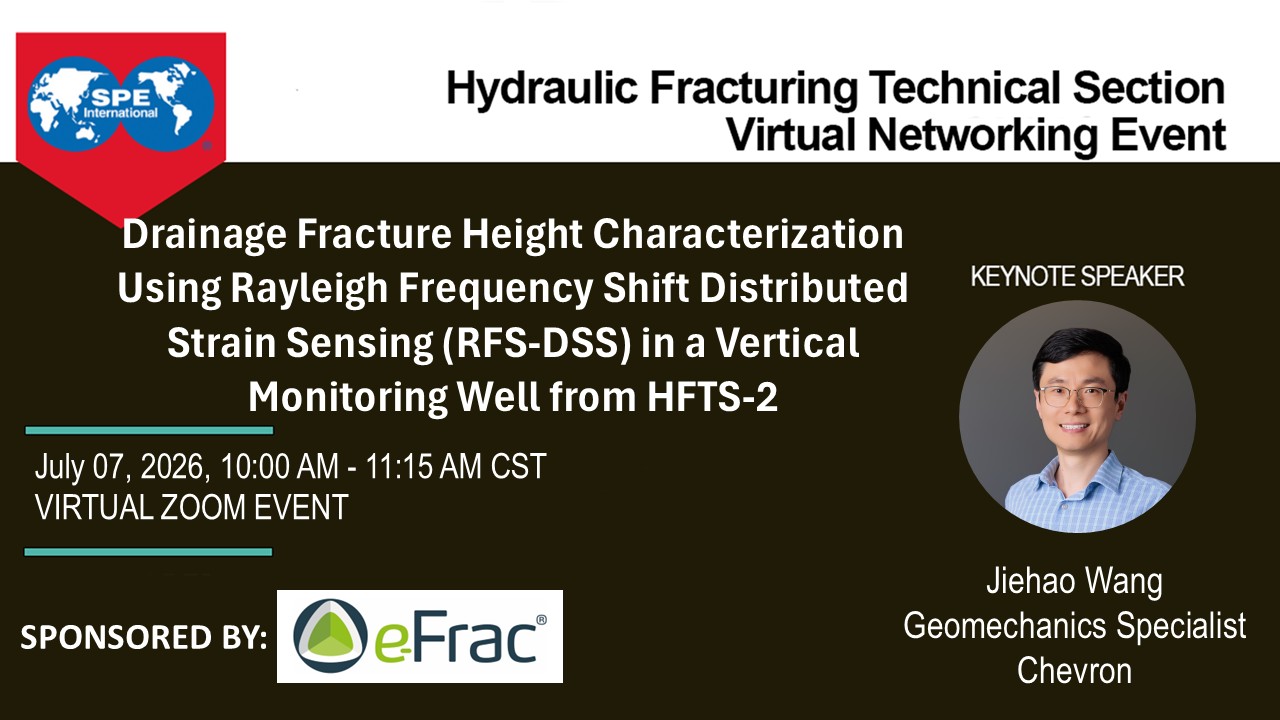
HyFTS Webinar (July 07, 2026, 10:00 AM – 11:15 AM CST)
Register here: https://lnkd.in/gGQ_5yFb
Keynote Speaker: Jiehao Wang, Geomechanics Specialist, Chevron
Title: Drainage Fracture Height Characterization Using Rayleigh Frequency Shift Distributed Strain Sensing (RFS-DSS) in a Vertical Monitoring Well from HFTS-2
Abstract:
Understanding drainage fracture height is critical for optimizing multi-bench unconventional reservoir development and improving forecasting reliability. Rayleigh Frequency Shift Distributed Strain Sensing (RFS-DSS) can measure strain changes along fiber during hydraulic fracturing and production. RFS-DSS data acquired from fiber installed in vertical offset wells show potential for characterizing drainage fracture height. This study revisits the HFTS-2 dataset and provides new insights into the potential of RFS-DSS for drainage fracture height characterization through cross-disciplinary data analysis and numerical modeling.
This study first conducts a series of synthetic simulations using a fully coupled reservoir geomechanics model to characterize the strain responses induced by pressure depletion. Then, a cross-disciplinary analysis of the HFTS-2 dataset was performed, including RFS-DSS, low-frequency DAS, microseismic, pressure gauge, geochemistry, and geological lithology data. It enables a comparison between drainage height interpreted by RFS-DSS and created/drainage fracture height determined by other surveillance methods. This is followed by a field-scale fracturing and production simulation to further validate the interpretation.
Simulation results from synthetic cases with various fracture and reservoir configurations were used to build a reference catalogue that supports the interpretation of RFS-DSS data in field applications. The RFS-DSS data in HFTS-2 was acquired during a well interference test. Pressure gauges show continuous pressure decrease in far-field even when wells are shut-in, enabling the interpretation of drainage height using this dataset. After 13 months of production, the RFS-DSS-interpreted drainage height was approximately 40% of the created fracture height. This interval is effectively bounded by calcite-rich layers above and below. A field-scale model of HFTS-2 successfully reproduced the observed RFS-DSS strain pattern during the interference test and confirmed that the compressive strain zone corresponds to the drainage height.
This paper demonstrates the potential of RFS-DSS in characterizing drainage fracture height and performing production allocation. RFS-DSS in vertical monitoring wells provides a more complete picture of vertical drainage profile compared to pressure gauge arrays and geochemistry methods, thanks to its spatially continuous measurement. Its application in multi-bench unconventional reservoirs has the potential to support the optimization of development strategies and completion designs, as well as the improvement of production forecasting.
Bio:
Jiehao is a Geomechanics Specialist with the Geomechanics COE and the Shale&Tight Business at Chevron, with seven years of industry experience in hydraulic fracturing technology, fracture surveillance, and geomechanical modeling. He has published more than 50 papers in peer reviewed journals and conference proceedings and holds three patents. Jiehao earned his Ph.D. in Energy and Mineral Engineering from Penn State University and his B.S. in Engineering Mechanics from China University of Mining and Technology.
Thank you to e-Frac® for sponsoring!